When “Seamless” Has Seams: The Phygital Well-Being Paradox
The same service can make life easier and harder—sometimes at the very same time.

You are rushing through an airport and order a meal on your phone. By the time you reach the gate, the food is waiting. No line, no scramble to find a restaurant, no wondering whether you have enough time before boarding.
Now widen the view. That system may require a smartphone and a cashless payment method. It may leave fewer staff members available to answer a question or help when something goes wrong. The convenience is real. So are the possible costs—and they may land on different people.
This is the phygital well-being paradox at the heart of our new paper in the Journal of Services Marketing.
Phygital? It's already part of your day
Phygital combines physical and digital. It describes experiences in which places, people, screens, and often algorithms work together. Ordering food through an airport app, using a wristband throughout a theme park, or meeting a doctor over video are all examples.
We often judge these experiences by a familiar set of measures: Was it fast? Easy? Personalized? Did I enjoy it? Those questions matter, but they rarely reveal the whole picture. A smooth interaction for one person can require extra work from an employee, exclude someone who cannot use the digital route, or create a new kind of pressure later.
Our paper proposes phygital well-being research to look at those effects across the whole service experience. It is a conceptual paper, meaning we build a framework and an agenda for research, with the aims for inspiration into a new view of phygital experiences.
Ways to look at well-being
The circular model below puts phygital well-being at the center. Surrounding it are eight connected dimensions: physical, social, emotional, intellectual, spiritual, environmental, financial, and occupational well-being. We feel strongly that each has a tension worth examining.
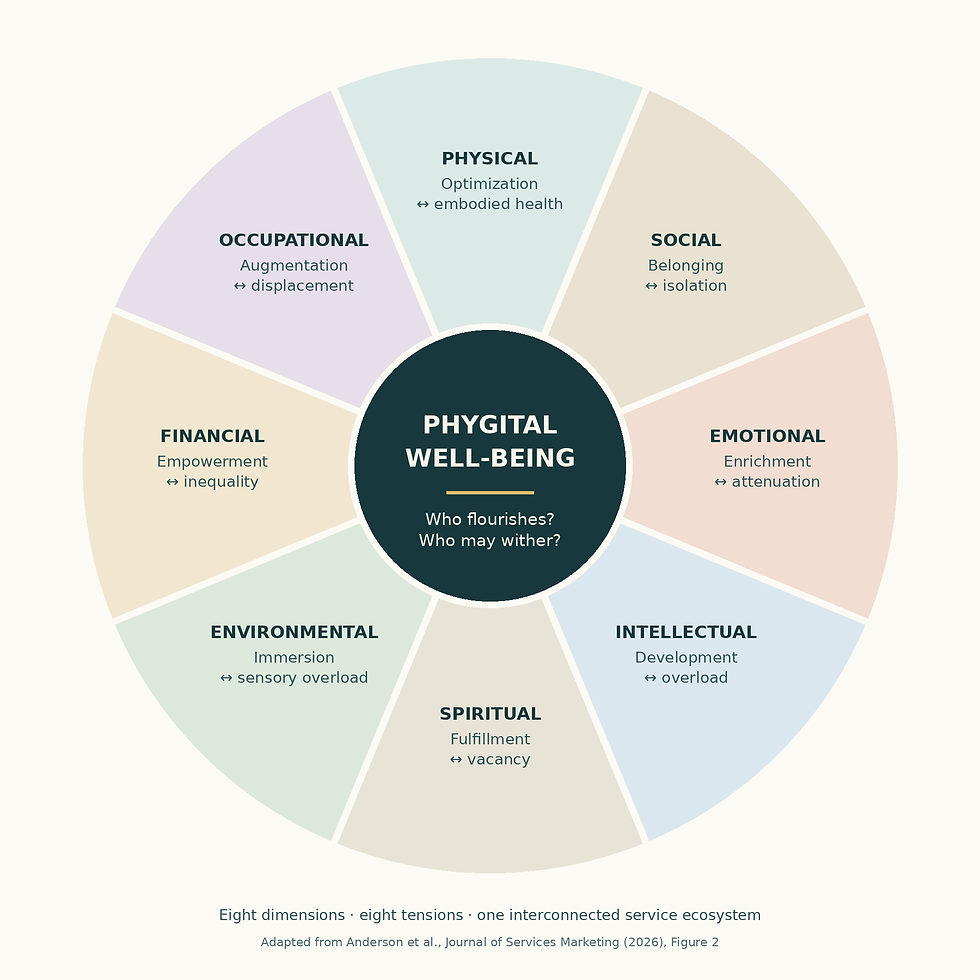
Take, for instance, the social dimension. A fitness platform may create belonging through shared goals and community, yet leave someone feeling isolated or constantly compared with others. In the intellectual dimension, a digital layer can help us learn while piling on so much information that we feel overwhelmed. And in the occupational dimension, technology may help employees do their jobs while also reducing their discretion or replacing parts of the work they value.
The visual reminds us that these effects connect, and often interact. A service that expands access can also change a relationship. A time-saving feature can impact a job. We cannot understand well-being by looking at one screen, one metric, or one customer alone; we need to look at the entire system.
Flourishing and withering can happen together
Flourishing describes experiences that enhance well-being, and withering describes experiences that diminish it. They are not necessarily two separate kinds of service. Both may emerge from the same experience: for different people, in different dimensions of life, or at different moments. Woah! That’s a lot. So let’s break it down…
Return to that airport meal. Being able to pre-order might make a stressful travel day easier. Requiring a phone could make the same service harder for another traveler to access. A worker might welcome a simpler ordering process while having fewer opportunities to help people face-to-face. These are possibilities to investigate, not outcomes we can assume for every airport or every person.

This is why “seamless” can be a misleading finish line. Sometimes a seam has truly been removed. Sometimes the effort has simply moved out of the customer's view.
What can a service provider do with this?
If you design or manage a service, start with one feature people already call a success: mobile ordering, an automated check-in, a loyalty app, or a self-service kiosk. Follow what happens beyond the moment the customer taps “complete.” Who handles an exception? What happens when a customer cannot use the digital route? Does a faster process give employees more room to help, or less?
The eight dimensions in our model offer a way to broaden that review. You do not need to score every dimension for every feature. Instead, look for the ones your service is most likely to affect, and ask customers and employees where the benefits and burdens actually show up. An airport ordering system, for instance, could be reviewed for access to a meal, emotional relief during a stressful trip, and the occupational experience of the people fulfilling orders. Check whether those answers differ across customers, employees, and moments in the journey.
Then use what you learn to make a specific design decision. A clear way to get human help, an option that does not require a smartphone, or more flexibility for staff to resolve exceptions, may address a tension that a speed metric would miss. Those are possibilities to test with the people affected, not universal fixes. But don’t forget to revisit the service after launch, too: a feature that feels helpful on the first use can feel different once it becomes the only way to participate.
Here’s my guiding service question for you:
Who flourishes here, who may wither, and what can we change once we see both?
Read “The phygital well-being paradox in the service ecosystem”, written with Ashley Hass, Karen Anne Wallach, Breanne A. Mertz, Ghalia Shamayleh, Debbie Laverie, Celia Van Wickel, and Sara Robin.


Comments